The Bronze Age Internet: The Tin Road and the First Globalization
By Sam Guss
We suffer from a chronological arrogance. We believe that “Globalization” was invented in the 20th century. We think the concept of a complex, international supply chain—where a component made in China is assembled in Vietnam and sold in New York—is a uniquely modern miracle enabled by container ships and fiber optics.
We look at the ancient world and imagine it as “local.” We imagine a potter in a village making a bowl for a farmer down the road. We imagine a King in Egypt who has never heard of a King in Britain.
But this view is not just wrong; it is a hallucination of isolation.
New chemical data released in mid-2025 by Project Ancient Tin has shattered this isolationist model. By analyzing the atomic fingerprints of metal ingots found in shipwrecks off the coast of Israel and Turkey, researchers have proven that the world of 1300 BCE was already “online.”
There was a network that stretched from the foggy mines of Cornwall, England, to the mountains of Uzbekistan, and down to the ports of Haifa and Alexandria.
It was the Tin Road. And it functioned exactly like the Internet. It was a decentralized, packet-switched network of value that kept the operating system of civilization (Bronze) running. When that network crashed in 1177 BCE, civilization crashed with it.
We are not living in the first global economy. We are living in the second one. And looking at the ruins of the first might tell us something about how fragile our own supply chain really is.
I. The Operating System: Why Tin Matters
To understand the network, you have to understand the code.
The “Bronze Age” is a misleading name. It sounds primitive. But Bronze is a high-technology alloy. You cannot dig it out of the ground. You have to synthesize it.
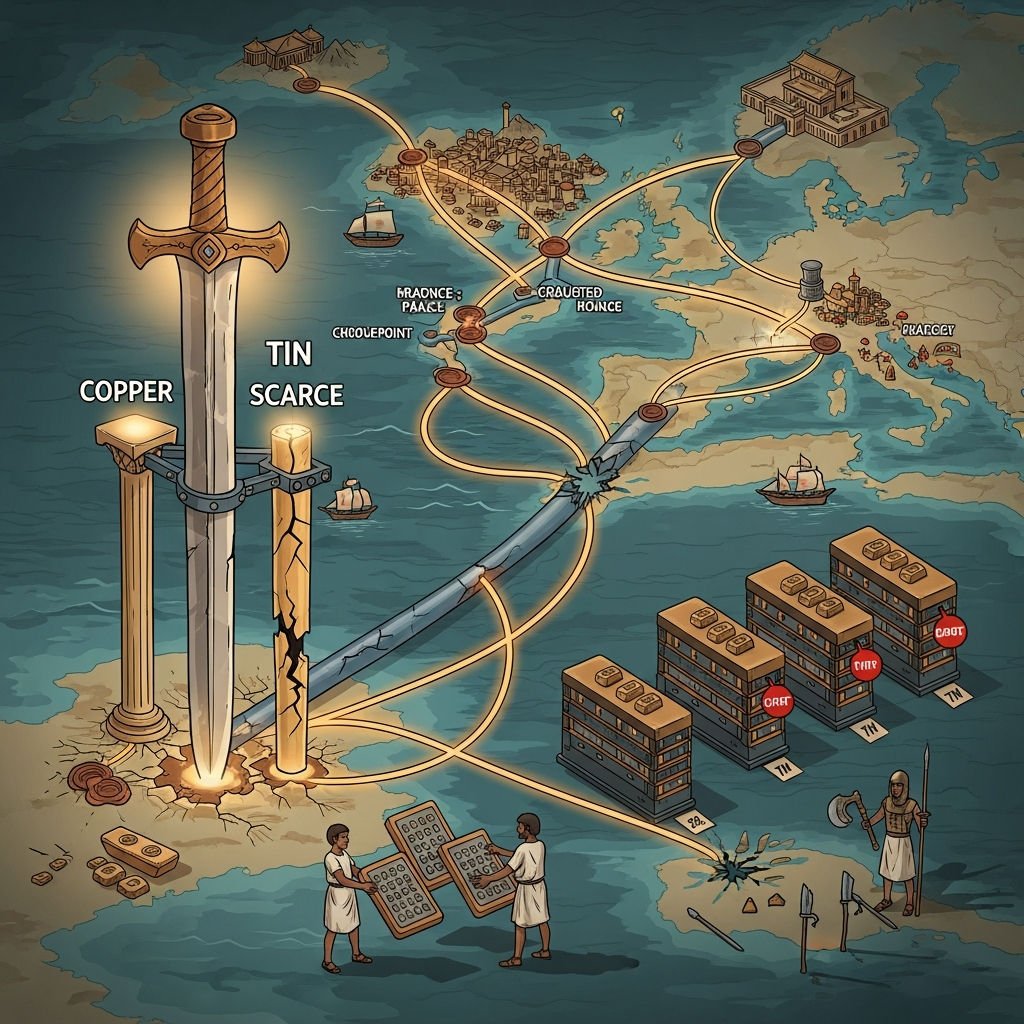
Copper is the base hardware. It is common. You can find copper in Cyprus, in Jordan, in Greece. But copper is soft. If you make a sword out of copper, it bends when you hit a shield. It is useless.
To turn Copper into Bronze, you need a patch. You need Tin.
If you add 10% Tin to 90% Copper, you get a chemical reaction. The metal becomes harder, golden, and capable of holding a razor edge. It becomes the “Killer App” of the ancient world. With Bronze, you can make effective weapons, durable tools, and status symbols.
But there is a geological bug in the system.
Tin is incredibly rare. There is almost no tin in the Mediterranean. There is no tin in Egypt. There is no tin in Babylon.
So, the great Empires of the ancient world—the superpowers of Egypt, the Hittites, and the Mycenaeans—faced a crisis. Their entire military and economic dominance depended on a resource they did not possess.
To survive, they had to build a network. They had to reach out to the “Barbarians” at the edge of the known world to get the software update.
II. The Discovery: The Chemical Passport
For decades, archaeologists argued about where the tin came from. Did it come from Afghanistan? Did it come from Spain? The ingots found in shipwrecks were silent. Metal, usually, doesn’t have a return address.
But in May 2025, a team led by researchers at Durham University and the University of Brooklyn finally cracked the code.
They used Isotope Analysis. Every mine on Earth has a unique chemical signature—a specific ratio of lead and tin isotopes determined by the age of the rock. It is a geological fingerprint.
The team analyzed tin ingots from the Uluburun Shipwreck (Turkey, c. 1300 BCE) and several wrecks off the coast of Israel (Haifa, Hishuley Carmel).
The results were shocking.
They found that the tin on these ships came from two distinct, distant sources:
- The Mušiston Mine in Uzbekistan (Central Asia).
- Cornwall and Devon (Southwest Britain).
Let that sink in.
A ship sank off the coast of Turkey in 1300 BCE. In its hold, sitting next to each other, were ingots mined by tribesmen in the mountains of Uzbekistan and ingots mined by clans in the wet, green hills of England.
These two sources are 6,000 kilometers apart. Yet their product ended up in the same hull, destined for the palaces of Pharaohs who likely didn’t even know Britain existed.
III. The Server: The Uluburun Shipwreck
If the mines were the “Data Centers,” the ships were the “Packets.”
The Uluburun Shipwreck is the most famous of these vessels. It wasn’t just a boat; it was a floating server carrying the source code of the Late Bronze Age.
Recovered from the seabed, its cargo is a testament to extreme globalization:
- 10 tons of Copper from Cyprus.
- 1 ton of Tin (the exact 10:1 ratio needed to smelt Bronze).
- Glass ingots colored with cobalt from Iran.
- Ebony wood from Nubia (Sudan).
- Amber from the Baltic Sea (Poland/Scandinavia).
- Ivory from hippos in the Nile.
This ship wasn’t Egyptian. It wasn’t Canaanite. It was International. The crew’s personal items suggest a mix of Mycenaeans, Canaanites, and perhaps mercenaries from the Balkans.
It was a Merchant Marine vessel that belonged to the Network, not the State.
These ships acted like the TCP/IP protocol. They moved the data (resources) between the nodes (Empires), indifferent to the politics of the Kings. As long as the tin flowed, the system remained stable.
IV. The Mechanism: The “Darknet” of the Steppe and the Sea
How did tin from Cornwall get to Israel in 1300 BCE? There was no Fedex. There was no Roman Empire to build the roads.
It moved through a Relay Network.
The “Techno-Mystic” view reveals a decentralized web of intermediaries.
- The Atlantic Leg: The British tin was likely paddled across the Channel in skin boats, carried up the Seine or Loire rivers in France, and walked over the Alps or Pyrenees to the Mediterranean coast.
- The Silk Road Leg: The Uzbek tin was carried by donkey caravans through the Hindu Kush, passed from pastoralist tribe to pastoralist tribe, until it hit the Mesopotamian river system.
This was a “Trustless Ledger.” The miner in Cornwall didn’t know the Pharaoh. He only knew the trader in the next valley. The tin changed hands twenty times, gaining value with every mile (like Bitcoin transaction fees).
This means the “Barbarians” (the Celts, the Nomads) were not outsiders. They were the System Administrators. They controlled the flow of high-tech resources. The Empires were dependent on the very people they claimed to despise.
V. The Techno-Mystic Take: The Fragility of Complexity
Why does this matter to us in 2026?
Because the Bronze Age Internet crashed.
In 1177 BCE, the system collapsed. The “Sea Peoples” invaded. The climate shifted (drought). The cities burned.
But systems theory suggests it wasn’t just the war that killed them. It was Hyper-Coherence. The network became too efficient. It became too tightly coupled.
Because Egypt relied on Hittite grain, and the Hittites relied on Cypriot copper, and everyone relied on Cornish tin, a failure in one node cascaded through the entire system. When the tin stopped flowing, the Bronze stopped. When the Bronze stopped, the armies couldn’t repair their weapons. When the armies failed, the cities were sacked.
We are currently building the exact same system.
- We rely on cobalt from Congo.
- We rely on chips from Taiwan.
- We rely on lithium from Bolivia.
We have built a “Just-In-Time” global civilization that assumes the roads will always be open.
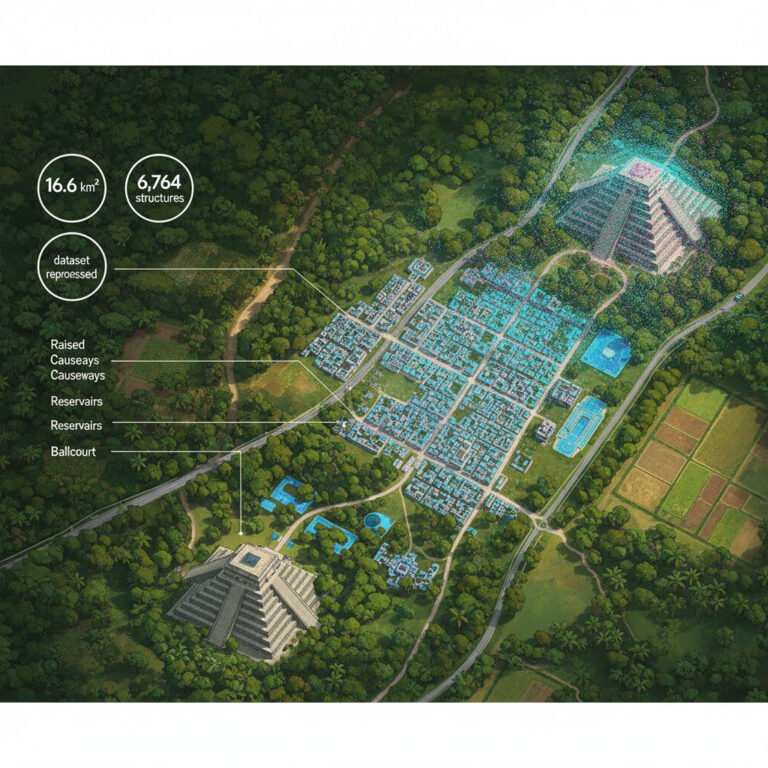
The Lidar scans of the Amazon (Article 1) showed us a sustainable, local resilience. The chemical scans of the Tin Road show us the opposite: a brilliant, fragile, global dependence.
VI. Conclusion: The Reboot
The next time you look at your smartphone, remember the Uluburun ship.
Your phone contains indium, gold, lithium, and copper from four different continents. It is an “Ingot” of the 21st century.
The Bronze Age Internet proves that the drive to connect is fundamental to our species. We will always build the Tin Road. We will always find a way to trade with the edge of the world.
But the 1300 BCE isotope data is also a warning. The network is not the territory. The network is a layer we build on top of the territory. And when the territory shakes—when the volcano erupts, or the drought comes, or the war starts—the network can snap.
The ancient world was globalized. And then, for 400 years, it wasn’t. The lights went out. The tin stopped coming.
We are surfing the same wave. We just have better Wi-Fi.
References & Further Reading:
- Project Ancient Tin (2025). “Isotope Analysis of Mediterranean Shipwrecks links to Cornish Sources.” Antiquity. Link to Journal
- Powell, W., et al. (2022). “Tin from Uluburun shipwreck shows small-scale commodity exchange fueled continental tin supply.” Science Advances. (The Uzbekistan connection).
- Cline, E. H. (2014). 1177 B.C.: The Year Civilization Collapsed. Princeton University Press. (The bible on systems collapse).
- Broodbank, C. (2013). The Making of the Middle Sea. (Context on maritime networks).
- National Geographic. “The Shipwreck that Rewrote History.” (Uluburun coverage).