The Year the Sun Blinked: 536 AD and the Great Reset
By Sam Guss
We often use the term “Dark Ages” as a metaphor. We think it refers to a lack of books, or a decline in philosophy, or the fall of Rome. We imagine it as a “dimming” of the intellect.
But new climate archaeology proves that the darkness wasn’t a metaphor. It was literal.
In the year 536 AD, the sun turned off.
For 18 months, a mysterious “dry fog” covered Europe, the Middle East, and parts of Asia. The sun shone with the brightness of the moon. Temperatures plummeted. Snow fell in Mesopotamia in the middle of summer. Crops died in the fields from Ireland to China.
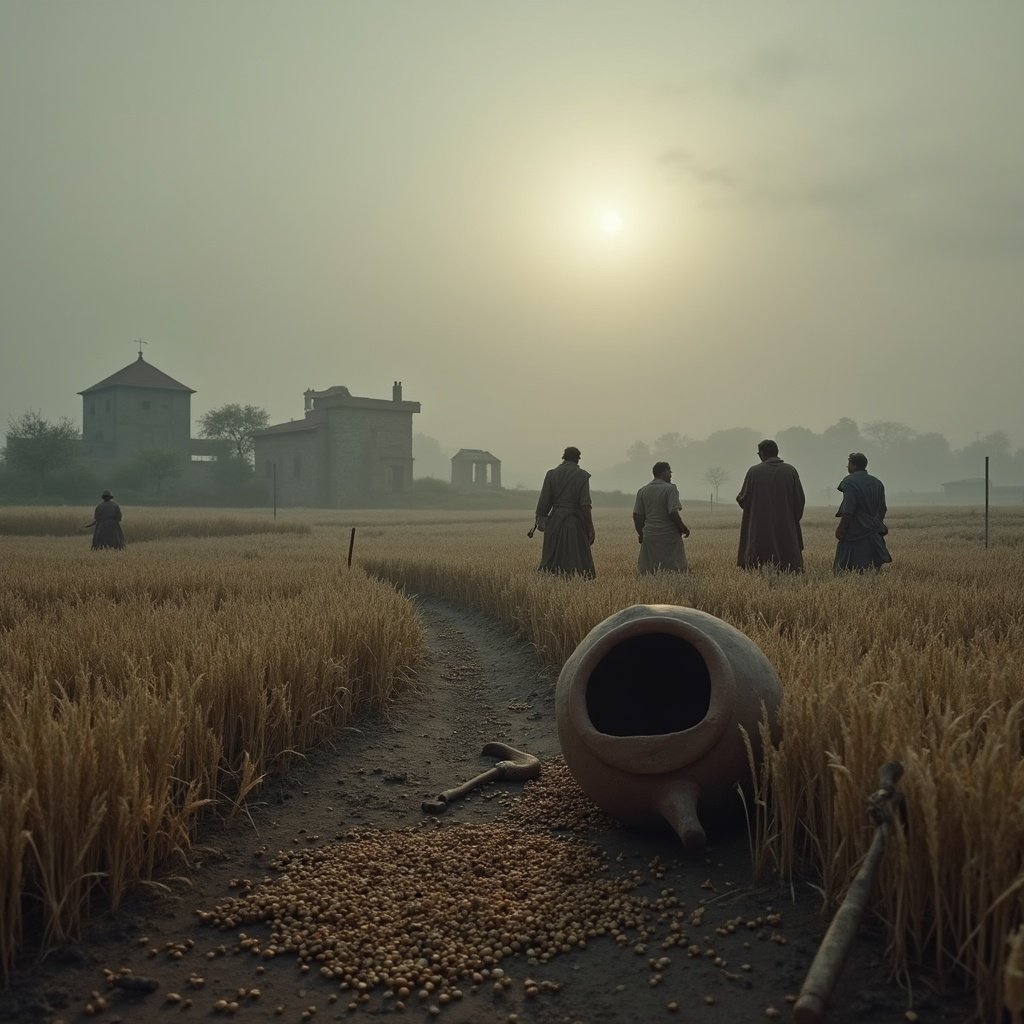
This wasn’t just a bad season. It was a Hard Reset of the planetary operating system.
Historian Michael McCormick recently called 536 AD “the worst year to be alive.” And thanks to new high-precision ice core data and tree-ring analysis (dendrochronology), we finally know why the lights went out.
We weren’t punished by God. We were punished by a Volcano.
I. The Witness Testimony: “The Sun Has No Ray”
Before we look at the science, we must look at the horror. The primary sources from 536 AD read like Lovecraftian fiction.
Procopius, the Byzantine historian, wrote from Constantinople:
“For the sun gave forth its light without brightness, like the moon, during the whole year… men were free neither from war nor pestilence nor any other thing leading to death.”
Cassiodorus, a Roman statesman, wrote:
“The sun seems to have lost its wonted light, and appears of a bluish color. We marvel to see no shadows of our bodies at noon.”
John of Ephesus described the famine:
“The wine tasted like sour grapes… the bread like rotting wood.”
Imagine a world where your shadow disappears. Imagine a “Blue Sun” that provides no heat. For a society that worshipped the divine order of the seasons, this was the Apocalypse. It broke the psychological contract between Man and Nature.
II. The Black Box: The Ice Core Data
For centuries, historians didn’t believe the accounts. They thought Procopius was being dramatic.
But in 2018, a team led by McCormick and glaciologist Paul Mayewski analyzed a glacier in the Swiss Alps (the Colle Gnifetti glacier). They used a laser to carve slivers of ice 120 microns thick—allowing them to read the weather history of Europe month by month.
They found the smoking gun.
In the layer corresponding to early 536 AD, they found microscopic shards of Tephra (volcanic glass). The chemical fingerprint matched a massive eruption in Iceland (or possibly North America).
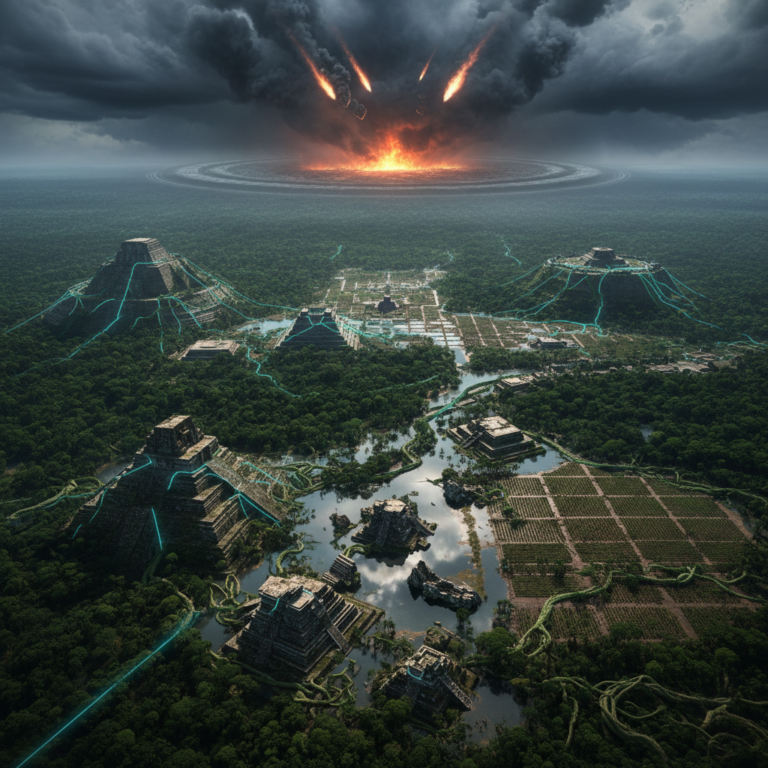
This volcano ejected millions of tons of ash and sulfur dioxide into the stratosphere. The sulfur reacted with water vapor to form a “Sulfate Aerosol Veil”—a massive, reflective blanket that wrapped around the Earth and bounced the sunlight back into space.
It was a Volcanic Winter.
And it didn’t just happen once. The ice cores show a second massive eruption in 540 AD, and a third in 547 AD. It was a “Cluster Event.” The planet was hammered three times in a decade.
III. The Mechanism of Collapse
This climate shock was the domino that knocked over the Ancient World.
1. The Famine: When the sun dimmed, photosynthesis slowed. Tree rings from 536-540 show almost zero growth. In Ireland, the chronicles record “a failure of bread.” In Scandinavia, the population crashed so hard that forests grew back over the farmland (likely inspiring the Norse myth of Fimbulwinter—the winter that precedes Ragnarok).
2. The Plague: Famine weakens the immune system. But the cold did something worse: it moved the rats. The temperature drop likely forced wild rodents in East Africa or Central Asia to migrate closer to human warmth. They brought their fleas. In 541 AD, five years after the darkness began, the Plague of Justinian (Yersinia Pestis) arrived in Egypt. It killed 50% of the population of the Byzantine Empire. It was the first bubonic plague pandemic.
3. The Geopolitical Shift: The chaos broke the stalemate of the ancient empires.
- The Avars fled the freezing Mongolian Steppe and hammered into Europe.
- The Arabs, facing shifts in the Red Sea climate, began the migrations that would eventually lead to the rise of Islam a century later.
- The Teotihuacan civilization in Mexico began its collapse around this time due to drought.
The map of the world was redrawn because the thermometer dropped 2 degrees.
IV. The Techno-Mystic Take: The Sky is the Ceiling
Why does 536 AD matter to a futurist?
Because it exposes our Vulnerability to the Sky.
We worry about nuclear war. We worry about AI. We worry about stock market crashes. These are human problems. But the Earth has its own agenda.
The Volcanic Winter of 536 reminds us that civilization exists in a very narrow “Goldilocks Zone” of climate stability. We are a “Solar Civilization.” Our entire food chain, our solar panels, our mood, our biology—it all runs on a specific calibration of light.
If you tweak the opacity of the atmosphere by 10%, the Roman Empire falls.
The Techno-Mystic sees this not as a tragedy, but as a system check. The Earth has a “Reset Button.” For the people of 536, it felt like magic. For us, it is physics. But the result is the same. When the Aerosol Veil descends, the stock market doesn’t matter. The only thing that matters is: Do you have grain?
V. Conclusion: The Long Shadow
The year 536 AD is the line in the sand. Before 536, you have “Antiquity”—togas, Rome, classical order. After 536, you have the “Middle Ages”—plague, knights, feudalism, survival.
The volcano birthed a new world.
We are currently living in a “Warm Period” (the Holocene). We think this is normal. But the ice cores tell us that the volcano is sleeping, not dead. The next 536 AD isn’t a question of if, but when.
And this time, we won’t just lose the crops. We will lose the Grid. A volcanic winter today would freeze the solar arrays and starve the biofuels.
The sun is not a guarantee. It is a subscription service. And sometimes, the server goes down.
References & Further Reading:
- McCormick, M., et al. (2018). “Volcanic forcing of climate cooling during the past 2,500 years.” Nature. (The study identifying the Icelandic source).
- Gibbons, A. (2018). “Why 536 was ‘the worst year to be alive’.” Science Magazine.
- Keys, D. Catastrophe: An Investigation into the Origins of the Modern World. (A controversial but fascinating book linking 536 to global geopolitical changes).
- Procopius. History of the Wars. (Primary source witness).
- Büntgen, U., et al. (2016). “Cooling and societal change during the Late Antique Little Ice Age from 536 to around 660 AD.” Nature Geoscience.