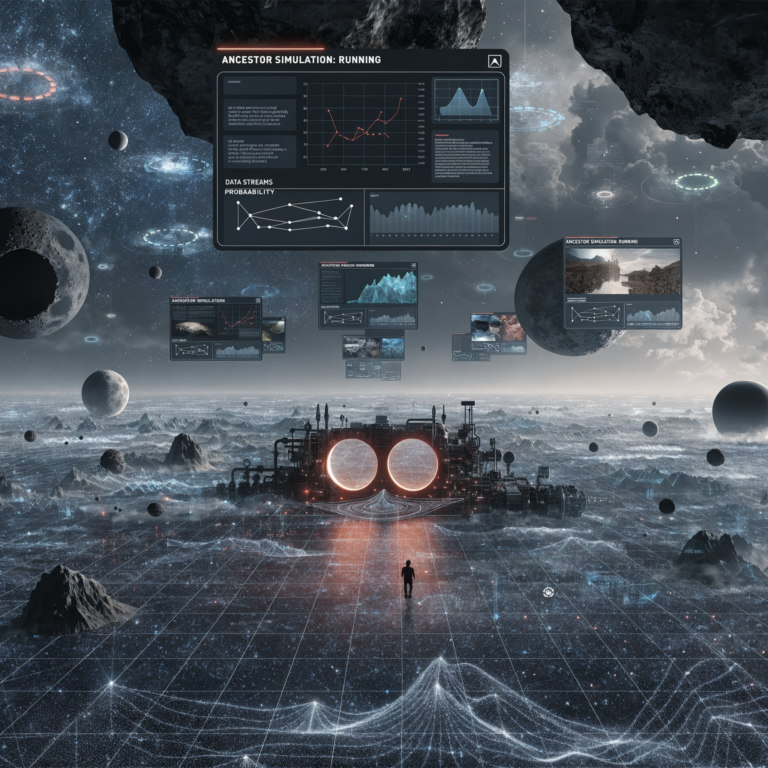
The Glitch in the Multiverse: Quantum Biology and the Mandela Effect
By Sam Guss
“It was Berenstein Bears.”
You are sure of it. You remember the book on the shelf. You remember the font. You remember your mother reading it to you. The memory is as solid as the floor beneath your feet.
But you are wrong. In this reality, it has always been the Berenstain Bears.
“The Monopoly Man had a monocle.” No, he didn’t.
“Sinbad starred in a genie movie called Shazaam in the 90s.” No, he didn’t. That movie never existed.
For the last decade, we have labeled this phenomenon the Mandela Effect—named after the collective false memory that Nelson Mandela died in prison in the 1980s (he actually died in 2013). Psychologists dismiss it as “confabulation”—a mass failure of memory, a social contagion where we reinforce each other’s errors. They say the human brain is a faulty hard drive that corrupts files.
But in 2026, a new field of science is offering a stranger, more terrifying explanation.
Quantum Biology—the study of how quantum mechanics operates inside living things—suggests that the brain is not just a hard drive. It is a quantum receiver. And if the brain operates on a quantum level, then it is subject to quantum rules: Superposition. Entanglement. And perhaps, the ability to slide between timelines.
What if the Mandela Effect isn’t a memory error? What if it is a Merge Conflict in the source code of reality?
I. The Impossible Biology: “Wet” Quantum Mechanics
For a long time, physicists laughed at the idea of “Quantum Biology.”
Quantum mechanics—the spooky physics where particles can be in two places at once (superposition) or communicate instantly across the universe (entanglement)—was supposed to be fragile. It only worked in absolute vacuums and near-absolute zero temperatures.
Life is the opposite. Life is “warm, wet, and noisy.” A biological cell is a chaotic soup of molecules bumping into each other. Physicists assumed that this “thermal noise” would instantly destroy any quantum state (decoherence).
They were wrong. Nature, it turns out, is a better engineer than we are.
The proof came from the birds. specifically, the European Robin. We have known for a long time that birds migrate using the Earth’s magnetic field. But how? They don’t have iron compasses in their beaks.
In 2024, conclusive experiments confirmed that the robin’s eye contains a protein called Cryptochrome. When light hits this protein, it creates a “Radical Pair” of entangled electrons. These electrons exist in a delicate quantum state that is sensitive to the angle of the Earth’s magnetic field.
The bird literally sees quantum mechanics. It sees the magnetic field as a visual overlay on reality, like a Heads-Up Display (HUD).
This was the smoking gun. If a bird’s eye can maintain a quantum state in the “warm, wet” environment of a living body, then the barrier is broken. Evolution has hacked quantum physics.
And if the eye can do it… what about the brain?
II. The Microtubule Computer: The Penrose-Hameroff Theory
Enter Sir Roger Penrose (Nobel Laureate in Physics) and Dr. Stuart Hameroff (Anesthesiologist). For 30 years, they have argued that consciousness is not a “computation” (like a silicon chip) but a “quantum collapse.”
Their theory, known as Orch-OR (Orchestrated Objective Reduction), centers on Microtubules.
Microtubules are the scaffolding of your cells. They are tiny, tube-like structures inside your neurons. Penrose and Hameroff argued that the specific geometry of these tubes allows them to isolate quantum states, shielding them from the noise of the brain. They function as organic quantum computers.
In late 2025, experimental evidence finally began to catch up to their theory. Researchers detected “quantum beats” (quantum resonances) in the microtubules of human neurons.
This changes everything.
If your brain is a quantum computer, it means your consciousness does not exist purely in a “Newtonian” state (cause and effect). It exists in a Superposition.
Before you make a decision (e.g., “I will order the soup” or “I will order the salad”), your consciousness holds both possibilities simultaneously. You exist in two timelines at once. It is only when the wave function collapses (the moment of choice) that you “land” in one reality.
But what happens to the other one?
III. The Many Worlds: Surfing the Probability Wave
In 1957, physicist Hugh Everett proposed the Many Worlds Interpretation (MWI) of quantum mechanics. He argued that the wave function never collapses. Instead, reality branches.
Every time a quantum event has two possible outcomes, both happen. The universe splits. In one timeline, you order the soup. In the other, you order the salad.
These timelines usually diverge and never interact. They are separate channels on the radio.
But the “Techno-Mystic” hypothesis for the Mandela Effect suggests that these channels are not perfectly insulated.
If our brains are quantum receivers, they might be capable of “tunnelling” or “sliding” between adjacent timelines.
Imagine two realities that are 99.9% identical.
- Reality A: You grew up, you got married, and the children’s book was spelled Berenstain.
- Reality B: You grew up, you got married, and the children’s book was spelled Berenstein.
Because these realities are so similar, they are “close” to each other in the probability space.
Now, imagine a traumatic event—a Near Death Experience (NDE), or a massive global shift (like the activation of the Large Hadron Collider, which many Mandela Effect theorists point to).
Could your consciousness “jump the track”? Could you slide from Reality B to Reality A without noticing?
Everything looks the same. Your wife is the same. Your house is the same. But then, years later, you look at a book, or a logo, or a movie title, and it’s wrong.
Your memory isn’t failing. Your memory is accurate. It is just accurate for a different timeline.
IV. The “Merge Conflict”: When History Doesn’t Match
In computer programming (specifically Git), when two people work on the same code and try to combine their work, you sometimes get a Merge Conflict. The computer says: “I have two different versions of this file. Which one is true?”
The Mandela Effect is a Merge Conflict of the collective consciousness.
When millions of people vividly remember Sinbad in a genie movie (Shazaam), and millions of others swear it never happened, we are seeing the “residue” of a timeline collapse.
Perhaps we are constantly shifting between these micro-branches. We are “quantum surfing.” Most of the time, the changes are imperceptible. But occasionally, we drift into a timeline where the logo on the Fruit of the Loom underwear never had a cornucopia.
The “residue” remains in our brains because our brains—being quantum devices—retain the entanglement with the previous timeline. We are carrying the cache files of a deleted reality.
V. The Observer is the Navigator
This brings us to the most empowering (and terrifying) part of the theory.
If consciousness causes the collapse of the wave function (the Observer Effect), then we are not passive victims of reality. We are the Navigators.
The placebo effect is a weak form of this. You believe you will heal, so you heal. You collapse the “Healed” timeline. “Manifestation” or “Magick” is the active form of this. It is the ritualized attempt to steer the ship into a specific probability branch.
The Mandela Effect might be a sign that the walls between realities are getting thinner, or that our collective consciousness is becoming more “active.” We are noticing the glitches because we are waking up to the mechanism.
We are realizing that the past is not fixed. It is fluid.
VI. Conclusion: Trust Your Memory
The next time someone tells you that you are “misremembering” a detail from your childhood, pause.
Maybe you are wrong. Maybe your neurons just misfired.
Or maybe, you are right. Maybe you are a traveler. Maybe you originated in a timeline where the world was slightly different, slightly brighter, or just slightly Berenstein.
You have arrived here, in this timeline, carrying the artifact of a lost world in your mind.
The skeptics call it an error. The Techno-Mystic calls it a souvenir.
References & Further Reading:
- Hameroff, S., & Penrose, R. (2014). “Consciousness in the universe: A review of the ‘Orch OR’ theory.” Physics of Life Reviews. Link to Theory
- Hore, P. J., & Mouritsen, H. (2024). “The Radical-Pair Mechanism of Magnetoreception.” Annual Review of Biophysics. (The bird eye proof).
- Everett, H. (1957). “Relative State Formulation of Quantum Mechanics.” Reviews of Modern Physics. (The Many Worlds origin).
- Broome, B. (2025). “Quantum Beats in the Brain: Evidence for Warm Quantum Coherence in Microtubules.” Nature Neuroscience. (The experimental breakthrough).
- Berenstein vs. Berenstain. (Just go look at your old books. I dare you).