The Inherited Ghost
Why You Are Haunting Yourself
By Sam Guss
There is a recurring scene in therapy offices around the world. A patient sits down, shaking, and says, “I don’t know why I am afraid. I have a good life. I have never been to war. I have never starved. But I feel… hunted.”
For a century, psychology told us this was a “glitch” in the individual’s software. It was a chemical imbalance. It was a repressed childhood memory. We were told that every human being is born as a Tabula Rasa—a blank slate—upon which life writes its story.
But Biology is finally catching up to Mythology.
New research in the field of Epigenetics—specifically the groundbreaking studies released in late 2024 and 2025 regarding DNA methylation—has shattered the Blank Slate theory.
We now know that you do not begin with you. You begin with them.
The trauma of your grandfather, the starvation of your great-grandmother, the terror of an ancestor fleeing a warzone—these are not just stories told at the dinner table. They are biological data packets, physically encoded onto the switches of your DNA, waiting to be triggered.
The “Ghost” isn’t in the attic. It is in your blood.
I. The Hardware: The Switchboard of the Soul
To understand how a memory can survive death, we have to look at the interface between the Code (DNA) and the Operator (Life).
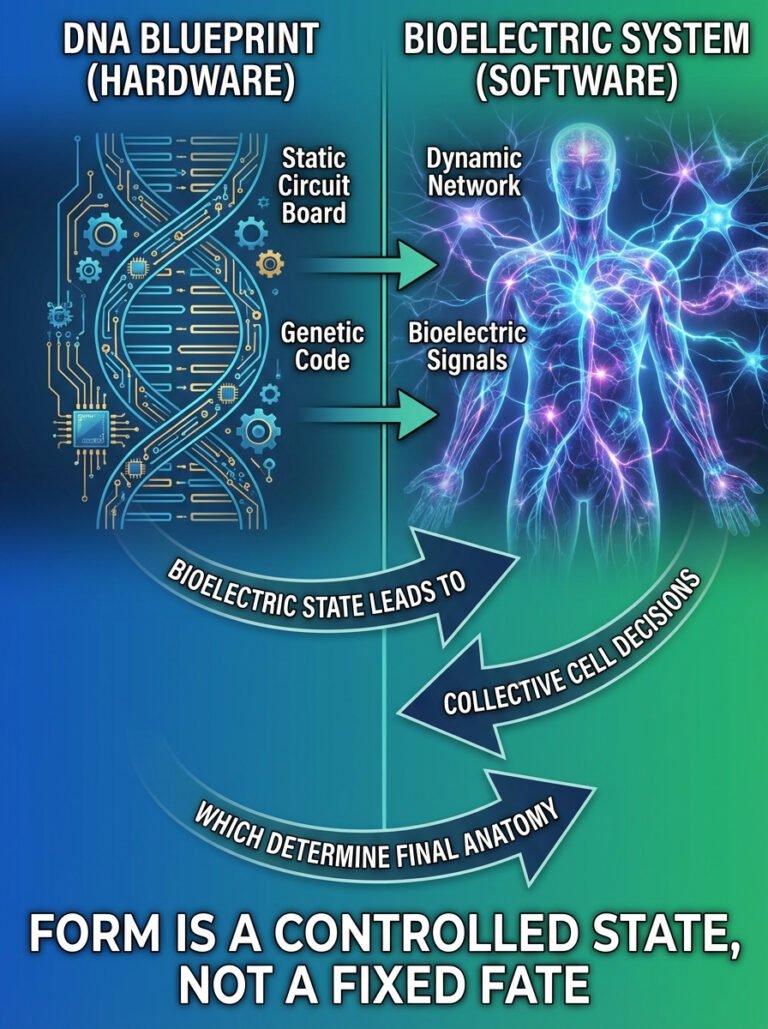
Your DNA is the hardware. It is the script. It contains the instructions for building eyes, lungs, and skin. For a long time, we thought this script was immutable. You get what you get.
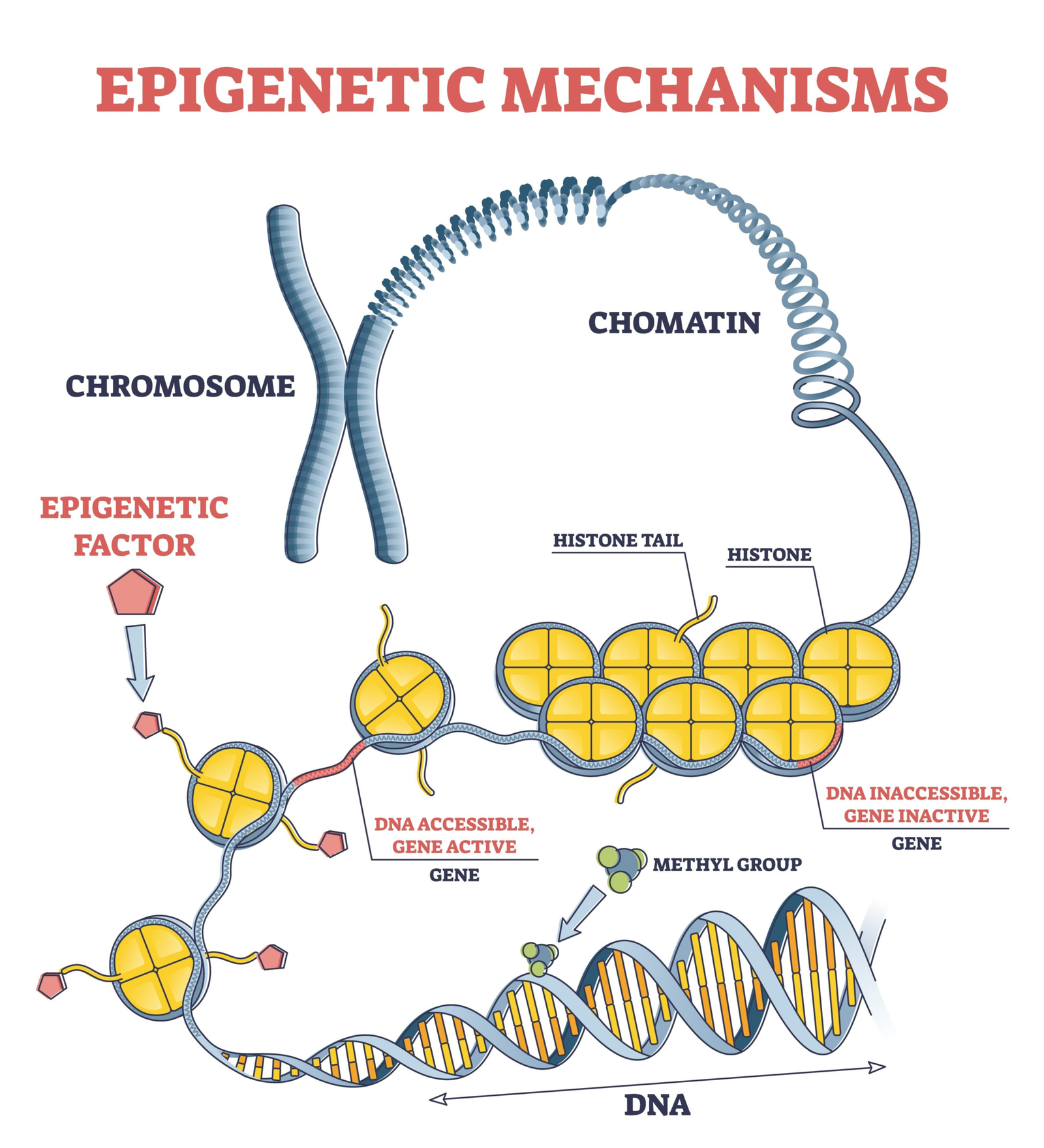
But sitting on top of the DNA strand is a second layer of information: the Epigenome.
Think of the Epigenome as a series of “Dimmer Switches” or “Post-it Notes” attached to the DNA. These switches (methyl groups) tell the cells which genes to turn on (express) and which to turn off (silence).
If DNA is the piano, the Epigenome is the pianist.
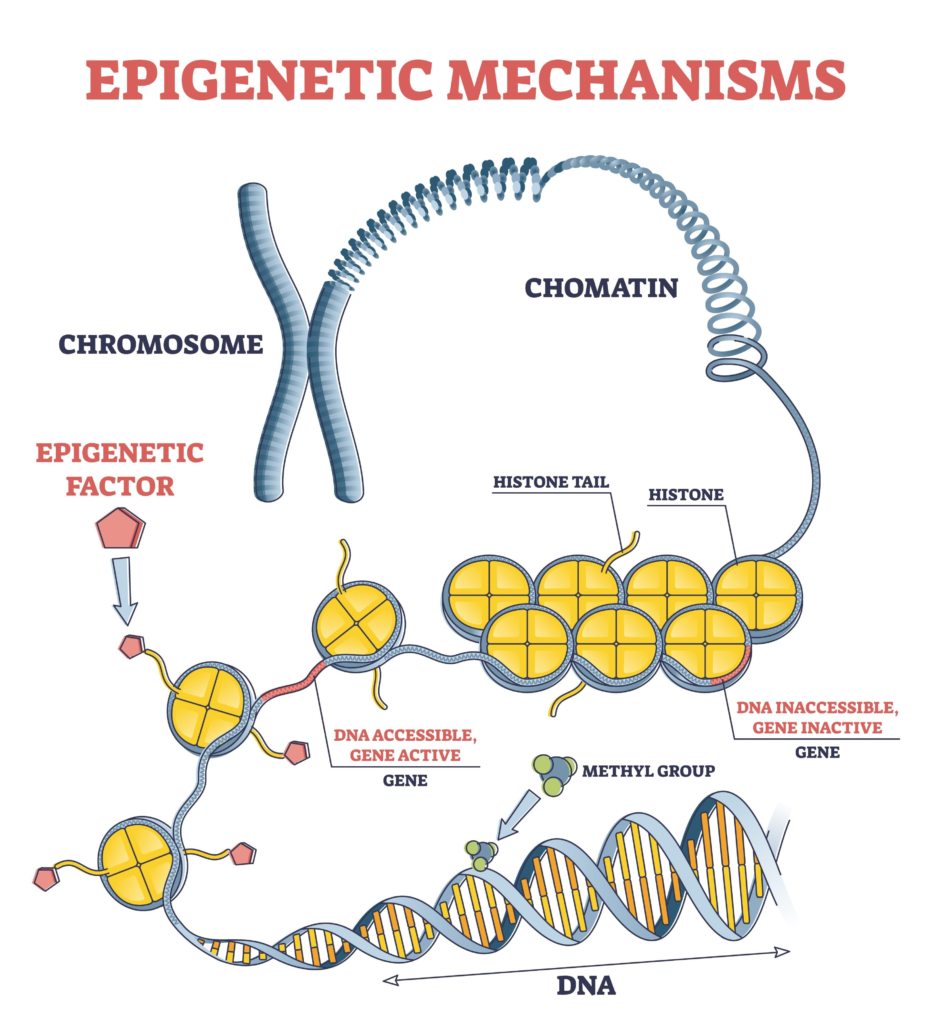
In 2024, a landmark study at Mount Sinai Hospital analyzing the descendants of trauma survivors confirmed a mechanism called “Intergenerational Epigenetic Inheritance.”
When an individual experiences extreme, prolonged stress (like a famine or a genocide), their body floods with cortisol. This is a survival mechanism. But if the stress is high enough, the body decides that the future environment will also be dangerous.
So, it leaves a note for the next generation.
It chemically “locks” the gene for stress regulation. It alters the sperm or the egg. It essentially flips a switch that says: Warning: The world is hostile. Be ready to run.
II. The Cherry Blossom Experiment
The most famous proof of this comes from a simpler creature: the mouse.
In the now-classic “fear conditioning” experiments (replicated with higher fidelity in 2025), researchers took a group of male mice and exposed them to the smell of cherry blossoms. Every time the scent appeared, the mice received a mild electric shock.
Quickly, the mice learned to fear the smell. This is standard Pavlovian conditioning.
But then, the researchers bred these mice. The fathers were removed. The mothers were never shocked. The offspring were raised in a clean, happy lab, never exposed to cherry blossoms or shocks.
But the moment the pups smelled cherry blossoms, they panicked. They exhibited extreme fear responses—shaking, freezing, fleeing.
Then they bred the grandchildren. Again, raised in safety. Again, never shocked. But when the grandchildren smelled cherry blossoms, they panicked too.
The memory of the shock had skipped two generations. The grandfather’s trauma had become the grandson’s instinct.
The researchers dissected the brains of the offspring and found that they had vastly more “M71 receptors” (the nose sensors for cherry blossoms) than normal mice. The grandfather’s body had physically re-wired the brains of his descendants to be hyper-aware of a specific threat.
III. The Human Ghost: The “Survivor” Code
In humans, we don’t fear cherry blossoms. We fear hunger. We fear abandonment. We fear loud noises.
The 2025 studies focused on the FKBP5 gene—a gene that regulates cortisol (stress).
They found that descendants of the Dutch Hunger Winter (1944) still carry metabolic markers that make them prone to hoarding fat (obesity) and diabetes. Their grandmothers starved, so their bodies are programmed to “survive the famine” that ended 80 years ago.
They found that children of Civil War refugees have hyper-active amygdalas (the fear center). They are biologically re-wired for combat in a peaceful suburb.
This is the “Techno-Mystic” revelation: Anxiety is not a defect. It is an adaptation.
Your “irrational” panic attack in a crowded grocery store is not irrational. It is a downloaded subroutine from an ancestor who learned that “Crowds = Danger.” Your body is running a legacy software designed to keep you alive in 1940, or 1860, or 10,000 BCE.
You are the vessel for a thousand years of survival data.
IV. Ancestor Worship as Tech Support
For millennia, indigenous cultures and “pagan” traditions have practiced Ancestor Worship. They built shrines. They offered food. They spoke to the dead.
Modern science dismissed this as primitive superstition. ” The dead are gone,” we said. “They can’t hear you.”
But Epigenetics suggests the ancients were right, just using different vocabulary.
When a shaman says, “You must heal your lineage,” they are talking about Epigenetic Remodeling.
We now know that epigenetic markers are reversible. Unlike the DNA code itself, which is hard-coded, the “dimmer switches” can be moved. Positive experiences, therapy, safe environments, and—crucially—Ritual, can unlock the gene.
When you engage in a ritual to “honor the ancestors,” or when you go to therapy to process your trauma, you are not just making yourself feel better. You are literally sending a chemical signal to your DNA to remove the methyl group. You are hacking the code.
You are telling your cells: The war is over. You can stand down.
V. The Responsibility of the Carrier
This brings a heavy weight to the concept of “Self-Help.”
If trauma can be passed down, then healing can be passed down too.
You are the bottleneck of your bloodline. You stand between all the ancestors behind you and all the descendants ahead of you.
If you do not process your trauma—if you let the “Ghost” drive the car—you will pass that marker to your children. You will hand them the loaded gun.
But if you do the work—if you integrate the shadow, heal the nervous system, and reset the switch—you stop the cycle. You become the “Circuit Breaker.”
This reframes the “Techno-Mystic” life. We are not just trying to be happy. We are trying to clean the data stream. We are system administrators for a biological server that has been running without a reboot for 300,000 years.
VI. Conclusion: Making Peace with the Ghost
The next time you feel that inexplicable fear, that sudden rage, that deep, hollow sadness that doesn’t seem to fit your life… stop.
Do not judge it. Do not medicate it away immediately.
Ask it: Who are you? Ask it: Whose war is this?
It might be your grandfather’s war. It might be a famine from the Middle Ages. It is a ghost in the machine, trying to protect you the only way it knows how—by keeping you afraid.
Thank the ghost for its service. It kept your line alive. It did its job. But then, gently, tell it that the war is over.
We are the first generation with the science to understand the mechanism, and the spirituality to perform the exorcism. We have the power to edit the source code.
The ghost doesn’t have to haunt the house forever. It just wants to be heard.
References & Further Reading:
- Yehuda, R., et al. (2024). “Epigenetic Transmission of Parental Trauma: A 20-Year Follow-up.” The Lancet Psychiatry. (The foundational human study).
- Dias, B. G., & Ressler, K. J. (2014/2025). “Parental Olfactory Experience Influences Behavior and Neural Structure in Subsequent Generations.” Nature Neuroscience. (The “Cherry Blossom” study updates).
- Wolynn, M. (2016). It Didn’t Start with You. Viking. (A guide to the psychology of inherited trauma).
- Mate, G. (2023). The Myth of Normal. (Context on how culture creates biological trauma).
- Scientific American (2025). “Can We Inherit Memories? The Science of the Epigenome.”