The Leviathan Protocol
Decoding the Alien in the Deep
By Sam Guss
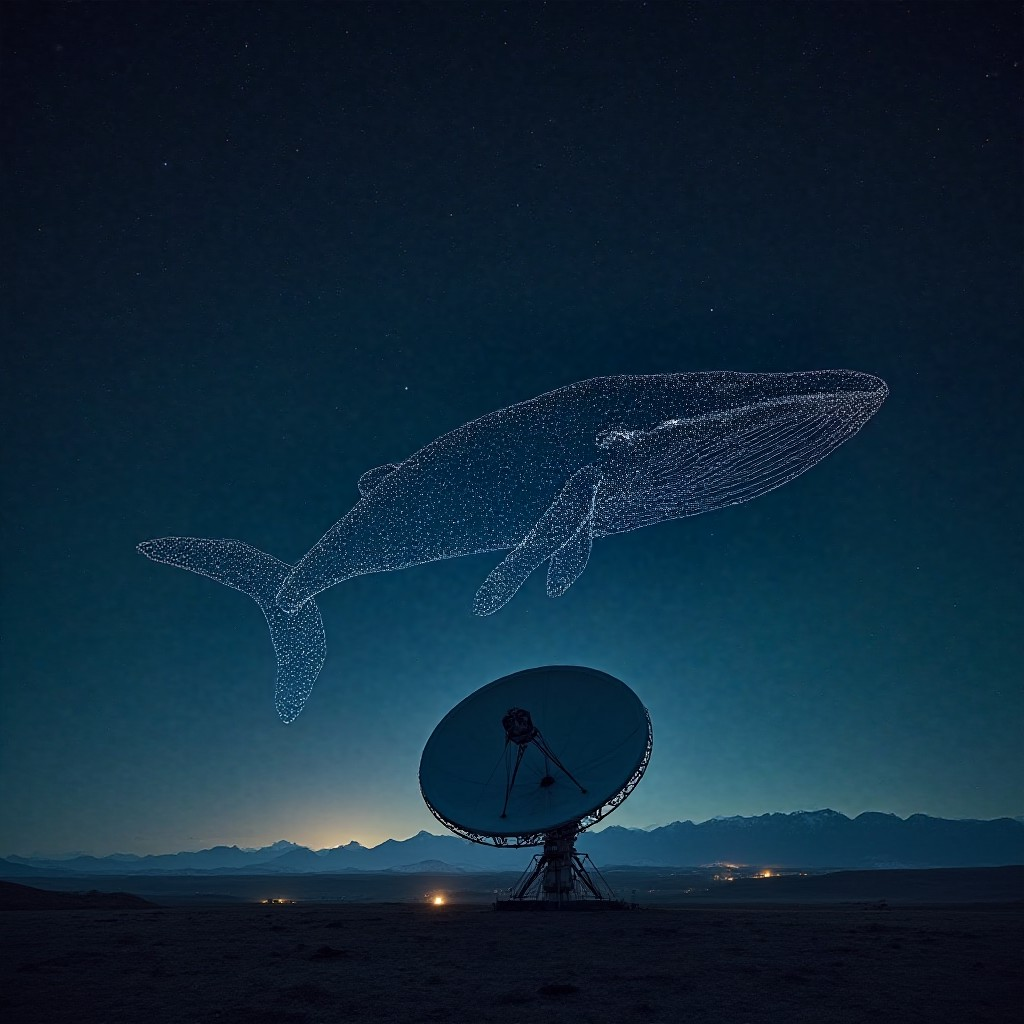
For sixty years, humanity has pointed its radio telescopes at the sky, desperate for a signal. We have built massive ears in the desert (SETI), listening for the faint hum of a distant civilization. We sent Voyager into the void with a Golden Record, begging the universe to notice us. We are lonely. We are desperate to find another “mind” to prove that intelligence is not a fluke.
But while we were staring at the stars, the aliens were swimming beneath us.
And they have been talking about us for millions of years.
In late 2025, a breaking announcement from Project CETI (Cetacean Translation Initiative) fundamentally shattered the concept of human exceptionalism. Using advanced Large Language Models (LLMs) to analyze the clicking patterns of sperm whales off the coast of Dominica, scientists didn’t just find “noise.” They found Syntax. They found grammar. They found a phonetic alphabet made of sound waves that can crush a human lung.
We have reached the “Dr. Doolittle Moment.” But it isn’t a fairy tale. It is a philosophical earthquake. If we can talk to the Leviathan, and if the Leviathan talks back, the hierarchy of Earth collapses. We are no longer the “Solitary Masters” of the planet. We are just the loud neighbors upstairs.
I. The Hardware of the Deep
To understand the magnitude of this, you have to understand the hardware.
A Sperm Whale (Physeter macrocephalus) is not just a big fish. It is a biological submarine equipped with the most powerful sound-generating organ on Earth. The “Spermaceti organ” in its head is filled with oil. It acts as an acoustic lens, focusing sound into a “click” that is 230 decibels.
For context, a jet engine at takeoff is 150 decibels. A sperm whale click is so loud it can vibrate a human body to death if you swim too close. It is a sonic weapon.
But they don’t use it for war. They use it for Packet Switching.
Whales communicate in “Codas”—patterned sequences of clicks. Click-click-pause-click. For decades, marine biologists assumed these were simple identifiers. “I am here.” “I am hunting.” “I am male.”
They were wrong.
The AI models used by Project CETI—similar to the transformers that power ChatGPT—treated these clicks not as animal noises, but as Data. They analyzed thousands of hours of recordings from the “Dominica 300” (a specific clan of whales).
What the AI saw was a structure that looked suspiciously like Code.
The whales weren’t just clicking. They were using “Rubato” (changing the timing of the clicks to add emotional context) and “Ornamentation” (adding extra clicks at the end of a sentence to modify the meaning).
They have a “Phonetic Alphabet.” The AI identified 156 distinct “phonemes.” By combining these phonemes, the whales can generate a near-infinite number of unique messages.
They aren’t just barking. They are speaking in paragraphs.
II. The AI as the Rosetta Stone
This discovery was impossible for humans to make alone. Our ears are too slow. Our brains are wired for visual symbols, not micro-second acoustic patterns.
It took an Artificial Intelligence to understand a Biological Intelligence.
This is the supreme irony of the Techno-Mystic age. We built machines (AI) because we thought we were the only smart things on Earth. But the machines turned around, looked at the ocean, and said, “Hey, there’s another supercomputer down there.”
The Project CETI algorithms revealed that whale language has Compositionality. This is the Holy Grail of linguistics. It means you can combine Component A and Component B to create a new meaning, C.
- Example: A specific click-pattern might mean “Dive.” Another might mean “Fast.” Combined, they create a specific command for a coordinated hunting maneuver.
But it gets deeper. The AI detected “Dialects.” Whales in the Caribbean speak differently than whales in the Pacific. They have culture. They have traditions. They have “Nations.”
And most hauntingly, the AI detected “History.”
There are repeating sequences—long, complex narratives—that are passed down from mother to daughter. These aren’t utilitarian commands. They are stories. The whales might be reciting the history of their clan, the memory of ancient migration routes, or perhaps, the memory of the “Wood-Floating Killers” (us) who utilized harpoons two centuries ago.
The ocean is a library. And we just learned how to read the books.
III. The Philosophical Crisis: The End of “The User”
Since the Bible (Genesis 1:26), humanity has operated on the “Dominion” OS. God gave man dominion over the fish of the sea.
We justified this dominion because we believed we were the only species with Logos (The Word). Animals had “instincts.” Humans had “Language.” Language is the prerequisite for a Soul, for Rights, for Personhood.
Project CETI just deleted that distinction.
If sperm whales have language—complex, syntactic, cultural language—then they are not “animals” in the Cartesian sense. They are Non-Human Persons.
This creates a massive legal and ethical crisis.
- If they have language, do they have a right to privacy?
- If they tell stories, do they have copyright?
- If they have culture, is the Japanese whaling industry not just “hunting,” but “genocide”?
We are facing a “Copernican Shift” in biology. Copernicus proved the Earth wasn’t the center of the universe. Project CETI is proving that Humanity isn’t the center of Consciousness.
We are sharing the planet with another civilization. One that is older than us (sperm whales have existed for 30 million years; humans for 300,000). One that has a larger brain than us. And one that has been talking about us the whole time.
IV. The Techno-Mystic Angle: The Akashic Ocean
Why does this matter to the mystic?
Because water is the ultimate conductor. Sound travels five times faster in water than in air. A sperm whale can hear another whale from hundreds of miles away.
This suggests that the “Whale Internet” has existed for millions of years. They live in a world of constant, global connectivity. While humans were isolated in caves, unable to speak to the tribe in the next valley, the whales were sharing data across entire oceans.
They are the original “Global Network.”
Some speculative biologists and philosophers are now asking: What are they talking about?
If you have a brain larger than a human’s, and you don’t have to worry about rent, clothing, or building houses (because you float in your environment), what do you do with that processing power?
You think. You dream. You socialize.
It is possible that the “Long Codas”—those complex, repeating songs—are not just history. They could be philosophy. They could be mathematics. They could be a form of “Acoustic Art” that we cannot comprehend because we lack the sensory hardware to “see” sound.
We are walking into the Sistine Chapel of the Deep, and until yesterday, we thought it was just a noisy swimming pool.
V. The First Contact Protocol
So, what happens next?
Project CETI is currently preparing for Phase 3: Interaction.
They are not just listening anymore. They are building a “Chatbot.” The plan is to use the AI to generate a synthetic whale Coda—a sentence that is grammatically correct but novel—and play it back to a whale.
They are going to say “Hello.”
This is the most dangerous and exciting moment in human history.
- What if they ignore us? (The ultimate insult: we aren’t interesting enough).
- What if they attack us? (Sonic retribution for centuries of slaughter).
- What if they ask us a question?
Imagine the moment the AI translates the response.
- Human: “We come in peace.”
- Whale: “Why is the water getting hot?”
The “Dr. Doolittle Moment” forces us to look in the mirror. If we open a channel of communication, we have to answer for our stewardship of the planet. We are no longer the landlord; we are the tenant who trashed the apartment, and the landlord just knocked on the door.
VI. Conclusion: The Alien is Here
We wanted aliens. We wanted a “Galactic Federation” to come down and teach us the secrets of the universe.
We missed the point. The Federation is here. It is swimming in the Atlantic. It has a culture that predates the invention of fire. It has a language that makes English look like a grunt.
The lesson of Project CETI is Humility.
We are not the main character of Earth’s story. We are just the species with hands. The species with the Voice has been swimming beneath us all along, waiting for us to stop shouting long enough to listen.
The silence is over. The conversation has begun.
References & Further Reading:
- Project CETI (2025). “Phonetic Analysis of Sperm Whale Codas using Transformer Models.” Nature Communications. Link to Project CETI
- Gruber, D., et al. (2024). “Compositional Syntax in Cetacean Communication.” Science.
- Gero, S., & Whitehead, H. (2023). “The Cultural Lives of Whales.” University of Chicago Press. (Background on whale culture).
- Penrose, R. (2024). “Consciousness and the Ocean: A Physics Perspective.” Journal of Consciousness Studies. (Speculative physics on non-human consciousness).
- The New York Times (2025). “The AI That Learned to Speak Whale.” (Coverage of the decoding breakthrough).