The Satellite Satori: Decoding the Beta-Version of Humanity
The canopy of the Amazon is not a forest; it is a green shroud covering the tomb of a civilization that was more advanced than our own. As we initiate the final transmission of this dossier, we are looking through the eyes of orbiting gods—Synthetic Aperture Radar (SAR) and LiDAR—to witness the “Satellite Satori.”

The history of the human race is a lie agreed upon by those who lacked the bandwidth to see the big picture. For a century, the standard archaeological model—the “Clovis First” narrative—taught us that civilization was a slow, linear crawl out of the Neolithic mud. We were told that the Amazon was a pristine wilderness, a “counterfeit paradise” incapable of supporting large-scale urbanism. But the sensors don’t lie. As we peel back the layers of the Earth’s “skin” using laser-altimetry, we aren’t finding primitive huts. We are finding the geometric remnants of a global, pre-cataclysmic network. This is the Satellite Satori: the sudden, orbital realization that we are not the first “High-Tech” occupants of this hardware.
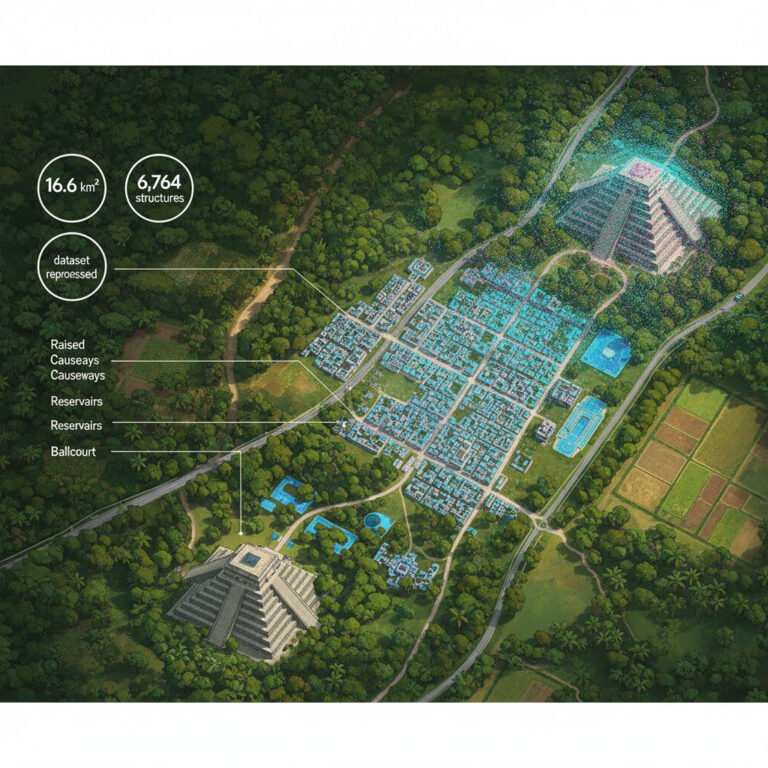
The catalyst for this awakening is LiDAR (Light Detection and Ranging). By firing millions of laser pulses per second from a low-flying aircraft, researchers can digitally “deforest” the landscape. In 2018, the PACUNAM LiDAR Initiative in Northern Guatemala revealed over 60,000 previously unknown Mayan structures. These weren’t isolated villages; they were part of a sprawling, interconnected megalopolis featuring elevated highways, complex irrigation systems, and defensive fortifications that suggest a population density comparable to modern-day Europe. As Dr. Christopher Fisher demonstrated in his 2016 discovery of the “Lost City of the Monkey God” in Honduras, these ruins are not outliers. They are the standard.
To the Techno-Mystic, these cities represent a “Beta Version” of the simulation—a previous iteration of human development that was “patched” out of existence. The timing of their disappearance aligns too perfectly with the Younger Dryas Impact Theory. As Dr. Richard Firestone and his team argued in 2007, a massive cosmic impact roughly 12,800 years ago triggered a global cataclysm, effectively “wiping the hard drive” of human civilization. The massive, precision-cut megaliths of Puma Punku and the Giza plateau are not the works of “ancient aliens,” but the “Artifacts” of a high-functioning biological race that understood the geometry of the simulation better than we do.
Consider the geometry. The earthworks found in the Acre region of Brazil, revealed only recently due to modern deforestation, show massive circles and squares that are mathematically perfect. These “Geoglyphs” were built long before the jungle existed. They are the foundations of a previous grid. When we look at them from space, they resemble nothing so much as a motherboard. This is the “Paleogenetic Script”—the realization that our “mythological” ancestors were likely the engineers of a global system that utilized the Earth’s natural telluric currents as a power source.
We have spent our modern era “discovering” what they already knew. We call it “GPS”; they called it “Ley Lines.” We call it “The Cloud”; they called it the “Akashic Record.” The difference is that their technology was integrated into the biological and geological substrate, while ours is an external, parasitic silicon shell.
The haunting thought that lingers in the orbital data is the cycle itself. If the “Beta Version” of humanity was wiped out by a system-wide reset, what triggers the next one? We are currently reaching the same level of global interconnectivity and environmental stress that preceded the last “Great Delete.” The Satellite Satori isn’t just about finding lost cities; it’s about recognizing the pattern of the loop. We are walking over the buried processors of a forgotten empire, and the “Update” is long overdue.
REFERENCES
- Firestone, R. B., et al. (2007). Evidence for an extraterrestrial impact 12,900 years ago. PNAS.
- Fisher, C. T., et al. (2016). Identifying Ancient Settlement Patterns through LiDAR in the Mosquitia, Honduras. Journal of Archaeological Science.
- Garrison, T. G., et al. (2019). Ancient lowland Maya complexity as revealed by airborne LiDAR. Science.
- Hancock, G. (2015). Magicians of the Gods: The Forgotten Wisdom of Earth’s Lost Civilization. Thomas Dunne Books.
- Heckenberger, M. J., et al. (2003). Amazonia 1492: Pristine Forest or Cultural Parkland? Science.
- Schoch, R. M. (2012). Forgotten Civilization: The Role of Solar Outbursts in Our Past and Future. Inner Traditions.