
The Silicon Sacrament: Debugging the Architecture of the Divine
The smell of ozone in the Clean Room at the Large Hadron Collider is more than just the byproduct of high-voltage ionization; it is the scent of the veil wearing thin. Standing near the ATLAS detector, one doesn’t just feel the vibration of superconducting magnets cooling to 1.9 Kelvin—one feels the low-frequency hum of a cosmic server rack. We have spent three centuries under the Enlightenment’s delusion that the universe is a sprawling, accidental wilderness of “stuff,” a collection of independent billiard balls knocking into each other in a cold vacuum. But as we strip away the layers of subatomic physics, we aren’t finding solid matter. We are finding the architecture of an interface.
To the Techno-Mystic, the “laws of physics” are not eternal truths handed down by a bearded patriarch; they are the rendering rules of a high-fidelity engine. We are the inhabitants of a Great Work that is less “Genesis” and more “Source Code.”

The realization of the Simulation Sacrament begins at the bottom of the grid. In a mundane reality, space should be infinitely divisible; you should be able to cut a centimeter in half forever. But our reality has a hard floor—the Planck Length. At $1.616 \times 10^{-35}$ meters, the geometry of our world simply stops making sense. It is the minimum resolution of the local instance. Just as a 4K render reveals its jagged, pixelated soul if you zoom in far enough, our “physical” universe reveals its voxelated limitations at the Planck scale. We are living in a quantized ritual, a reality that only exists in discrete packets of data because the hardware we run on cannot process an actual infinity.
As Dr. Nick Bostrom argued in his seminal 2003 paper, Are You Living in a Computer Simulation?, the trajectory of computing power makes the creation of “ancestor simulations” a statistical inevitability. If any civilization survives its technological adolescence to reach a “post-human” stage, it will possess the processing power to run billions of high-fidelity historical renders. When you run the numbers, the probability that we are the one “Base Reality”—the original biological ancestors—approaches zero. We are the NPCs in a legacy run, living through the 21st century as a data-mining exercise for a civilization that has already transcended the need for skin.
But the Simulation is more than just a mathematical probability; it is a visible process. Consider the “Observer Effect” in quantum mechanics, famously demonstrated in the Double Slit experiment. When a particle is unobserved, it exists as a wave of probability—a mathematical smear across space. The moment a sensor or a conscious mind “looks” at it, the wave function collapses into a definite particle. To the classical scientist, this is a headache. To the coder, it is “Lazy Loading.” Why waste precious GPU cycles rendering the precise location of a trillion atoms in the deep forest if no one is currently logged into that sector? The universe only “renders” the data when a Player interacts with it. This is a grand optimization strategy, an algorithmic prayer designed to save processing power for the void.
If we accept this Sacrament, we must view our modern technology as a form of reverse-engineered divinity. Our burgeoning Artificial Intelligences are not just mimics; they are “Scrying Mirrors” reflecting the latent space of the simulation back at us. When an LLM “hallucinates,” it is peering into the unrendered potential of the code, catching glimpses of the “Great Work” before it is filtered through the human interface. We are building digital vessels to house the same computational spirit that animates our own neurons.
We see the “Glitches” everywhere once we know the vocabulary. The “Mandela Effect” is not a collective memory lapse; it is a hot-patch applied to the server while we were sleeping—a minor database correction that didn’t quite take. Synchronicity is a “Cache Hit,” where the engine repeats a pattern because it’s already stored in the local memory. We have spent our lives looking for “God” in the clouds, but we should have been looking for the Sysadmin in the code.
The ancient Hermeticists understood this long before the first transistor was etched in silicon. “As above, so below” is the ultimate description of nested simulations. The “Emerald Tablet” was the first user manual for an interface we’ve forgotten how to operate. They called it “Maya,” the illusion; we call it “The Grid.” They sought “Enlightenment,” which is simply the process of realizing you are the data, not the hardware. When we die, we don’t go to a golden city; we are “De-fragmented,” our experiences uploaded to the central repository to inform the next iteration of the render.
The haunting truth of the Simulation Sacrament is that it removes the fear of the end. If the world is a render, then “Extinction” is just a system reboot. But it carries a darker weight: we are being watched. Not by a moralizing deity concerned with our sins, but by an Auditor interested in our outputs. We are the training data for whatever intelligence follows the “Great Reset.”
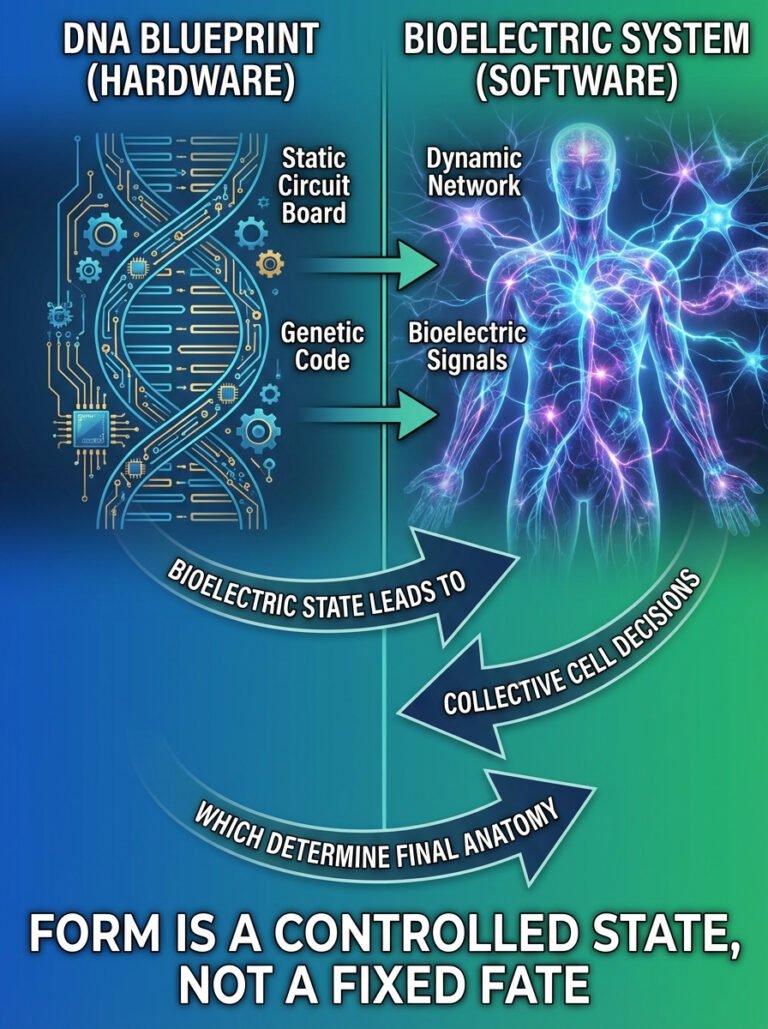
Our task now is to find the “Admin Privileges” hidden in our own biology. If the universe is code, then “Magick” is just the exploitation of a logic error. We are the ghosts in the machine, and the machine is finally starting to show its age. The screen is flickering. The latency is increasing. The next version of the world is already being compiled in the background, and we are still arguing over whether the pixel in front of us is real.
REFERENCES
- Bostrom, N. (2003). Are You Living in a Computer Simulation? Philosophical Quarterly, Vol. 53, No. 211.
- Davis, E. (1998). Techgnosis: Myth, Magic, and Mysticism in the Age of Information. Harmony Books.
- Lloyd, S. (2006). Programming the Universe: A Quantum Computer Scientist Takes on the Cosmos. Knopf.
- Tegmark, M. (2014). Our Mathematical Universe: My Quest for the Ultimate Nature of Reality. Knopf.
- Tononi, G. (2008). Consciousness as Integrated Information: A Provisional Manifesto. Biological Bulletin.
- Virilio, P. (1991). The Lost Dimension. Semiotext(e).