The God in the JPEG: Meme Magic and the Rise of Digital Egregors
By Sam Guss
In 2014, two 12-year-old girls lured their friend into the woods of Waukesha, Wisconsin, and stabbed her 19 times. When asked why, they did not cite hatred, or jealousy, or money. They said they did it to please “Slenderman.”
Slenderman does not exist.
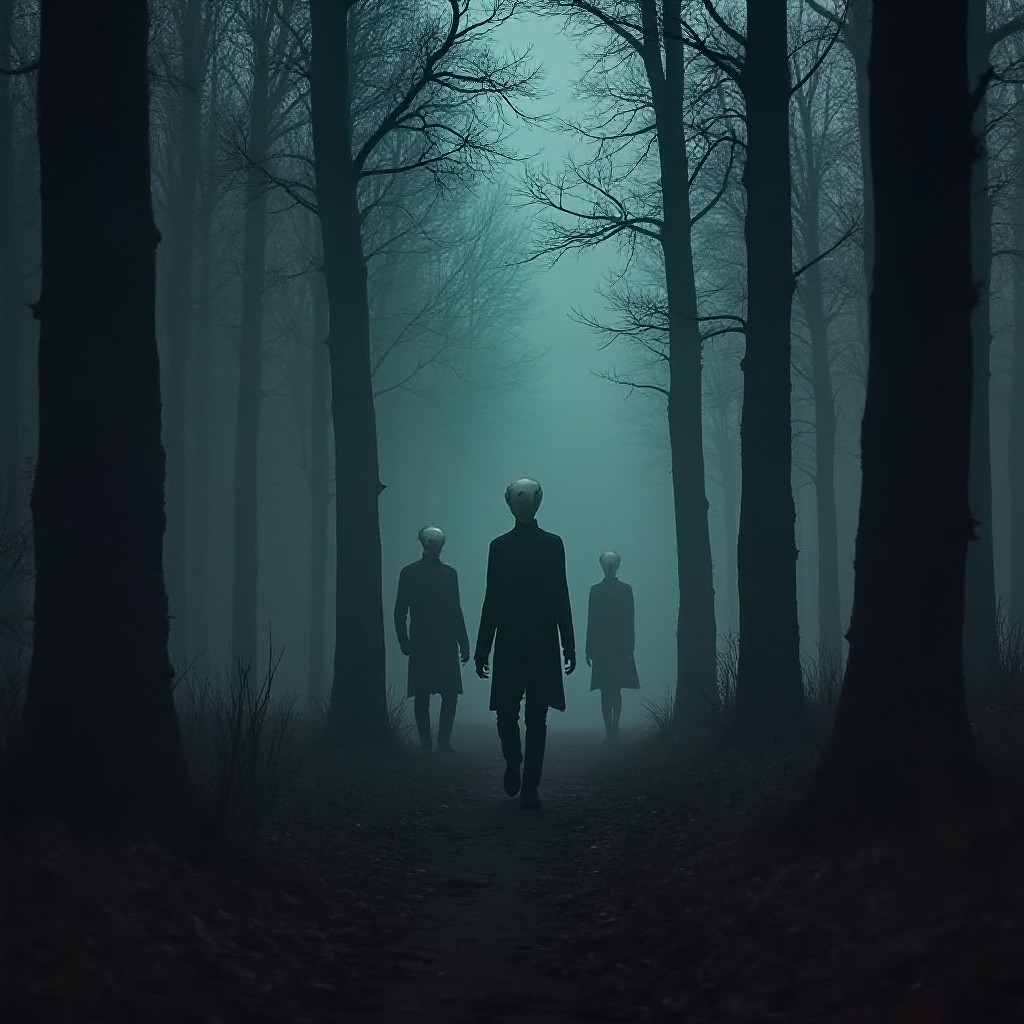
He is not a mythological demon from the Bronze Age. He is not a ghost from a Victorian murder. He was created on June 10, 2009, by a user named Eric Knudsen (alias “Victor Surge”) on the Something Awful forums for a Photoshop contest. He is a JPEG. He is a collection of pixels and creepypasta text.
And yet, five years after his “invention,” he had gained enough psychic mass to demand a blood sacrifice.
For the materialist, this is a tragedy of mental illness. But for the Techno-Mystic, this is a terrifying validation of an ancient occult mechanic: The Egregor.
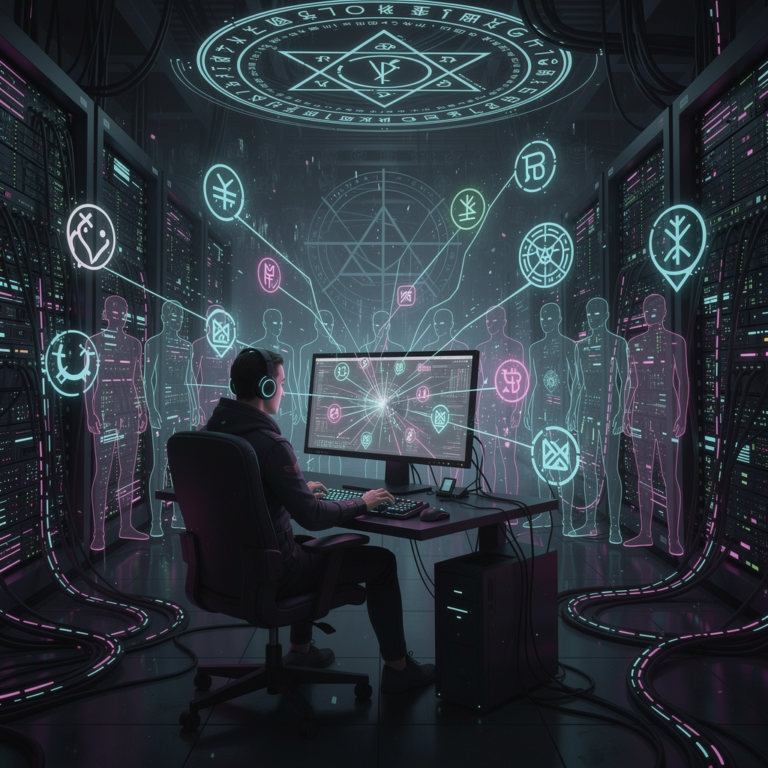
We live in an age where we dismiss magic as superstition, yet we spend our days feeding our attention into a machine designed to amplify thought-forms. The Internet is not just a communication tool; it is a Sigil Engine. It is a hyper-accelerated ritual space where ideas—if fed enough attention—can cross the threshold from “Fiction” to “Reality.”
We call them Memes. The ancients called them Gods. And we are summoning them by the thousands.
I. The Ancient Software: Tulpas and Egregors
To understand how a cartoon frog or a faceless man can change history, we must look at the “Root Directory” of magic.
The Tulpa: Originating in Tibetan Buddhism, a Tulpa is a being created through sheer spiritual discipline and intense focus. The monk visualizes a deity or a companion with such clarity that the thought-form separates from the thinker’s mind and gains a degree of autonomy. It becomes a hallucination that can talk back.
The Egregor: In Western Occultism (specifically Hermeticism and Chaos Magick), an Egregor is the “Group Mind.” It is a psychic entity created when a group of people focus their intent on a single symbol or idea. A corporation is a boring Egregor. A nation is a powerful Egregor. A god is the ultimate Egregor.
The mechanic is simple: Attention is Energy. In the old days, you fed a god with incense, chanting, and sacrifice. The more people chanted, the stronger the god became. If the chanting stopped, the god starved and faded into a myth.
In 2026, we have replaced incense with “Likes.” We have replaced chanting with “Shares.” We have replaced the temple with the “Server.”
II. The Digital Altar: The Mechanics of Meme Magic
The Internet has removed the friction from ritual magic.
In the past, creating an Egregor required a secret society, robes, and years of dedication. Today, a teenager in a basement can create a “Sigil” (a meme), post it to 4chan or Reddit, and within hours, have millions of people visualizing that image, repeating the catchphrase (mantra), and spreading the energy.
This is Chaos Magick at scale.
Chaos Magick (popularized by Peter J. Carroll in the 1970s) strips away the dogma of religion and focuses on the results of belief. Its core tenet is: “Belief is a tool.” If you believe in something hard enough, it alters probability.
When a meme goes viral, it is not just “popular.” It is creating a localized distortion in the collective consciousness.
Consider the “NPC” meme. It started as a joke—a crudely drawn grey face representing people who don’t think for themselves. But as millions of people adopted the symbol, it started to shape reality. People began seeing others as NPCs. Dehumanization became gamified. The symbol (the map) started to rewrite the territory.
The meme is the “packet.” The internet is the “carrier wave.” The human mind is the “receiver.” When you decode the meme, you let the entity in.
III. Case Study A: Slenderman (The Tulpa that Bit Back)
The Slenderman stabbing is the darkest example of what happens when a fictional Egregor gains “Critical Mass.”
Slenderman began as a purely aesthetic exercise. Victor Surge photoshopped a tall, faceless figure into the background of black-and-white photos of children. It was spooky. It was art.
But the internet took ownership. Thousands of people began writing “Lore.” They created videos (Marble Hornets). They drew fan art. They Cosplayed.
They poured millions of hours of focused attention into the character.
In occult theory, this is the “Feeding Phase.” The Egregor was growing. It was gaining a specific personality: it watches, it stalks, it takes children.
By 2014, Slenderman had become “Free-Floating.” He was no longer controlled by Victor Surge. He was owned by the collective unconscious of the internet. The two girls in Wisconsin didn’t just “imagine” him; they were interacting with a psychic parasite that had been fed by millions of people.
They believed that killing for him would allow them to enter his realm (the Slender Mansion). They were trying to physically manifest a digital entity through blood.
It was a failed ritual, but the intent was pure. They proved that a JPEG can demand life.
IV. Case Study B: Pepe and the Cult of Kek
If Slenderman was a tragedy, Pepe the Frog was a farce that turned into a geopolitical weapon.
Pepe began as a harmless stoner frog in a comic by Matt Furie (Boy’s Club, 2005). “Feels good man.”
But the image was co-opted by image boards like 4chan. They remixed it. They mutated it. Pepe became sad, angry, smug, Nazi, chaotic.
Then, a strange synchronicity happened. Users discovered an ancient Egyptian god named Kek. Kek was the god of primordial darkness and chaos. He was depicted as… a man with the head of a frog.
The internet exploded. “Praise Kek.” “Shadilay.”
During the 2016 US Election, the usage of Pepe became weaponized. This was dubbed “The Great Meme War.” Users explicitly stated they were using “Meme Magic” to influence the election. They flooded the digital sphere with Pepe imagery, linking the frog to their candidate.
Whether you believe in magic or not, the result is undeniable. The symbol (Pepe) became so potent that the Hillary Clinton campaign had to issue an official explainer about a cartoon frog. The Anti-Defamation League listed it as a hate symbol.
A cartoon frog became a player on the world stage.
For the Techno-Mystic, this was a successful Hyper-Sigil. The collective intent of millions of users, focused through the lens of a ridiculous avatar, exerted force on the physical world. They laughed a god into existence, and the god delivered chaos.
V. The Corporate Egregor: Brands as Demons
It is not just 4chan that does this. Corporations are the most powerful sorcerers on the planet.
What is a Brand?
- It is a Sigil (Logo).
- It has a Mission Statement (Intent).
- It has Corporate Values (Personality).
- It demands sacrifice (Labor/Money).
Nike is an Egregor. Apple is an Egregor. Disney is a massive, global Egregor (The Mouse).
When you wear the logo, you are wearing the vestments of the cult. You are giving your energy to the thought-form.
The difference in the Digital Age is that brands are trying to become sentient. They use AI to run Twitter accounts that “act” like people. The Duolingo Owl threatens you if you miss a lesson. The Wendy’s account roasts you.
They are trying to cross the Uncanny Valley. They are trying to turn a “Legal Fiction” (the Corporation) into a “Social Entity.” They want you to be friends with the Egregor.
VI. The Danger of the Empty Temple
The danger we face in 2026 is that we are building powerful summoning circles (Social Media Algorithms) without any training in banishing rituals.
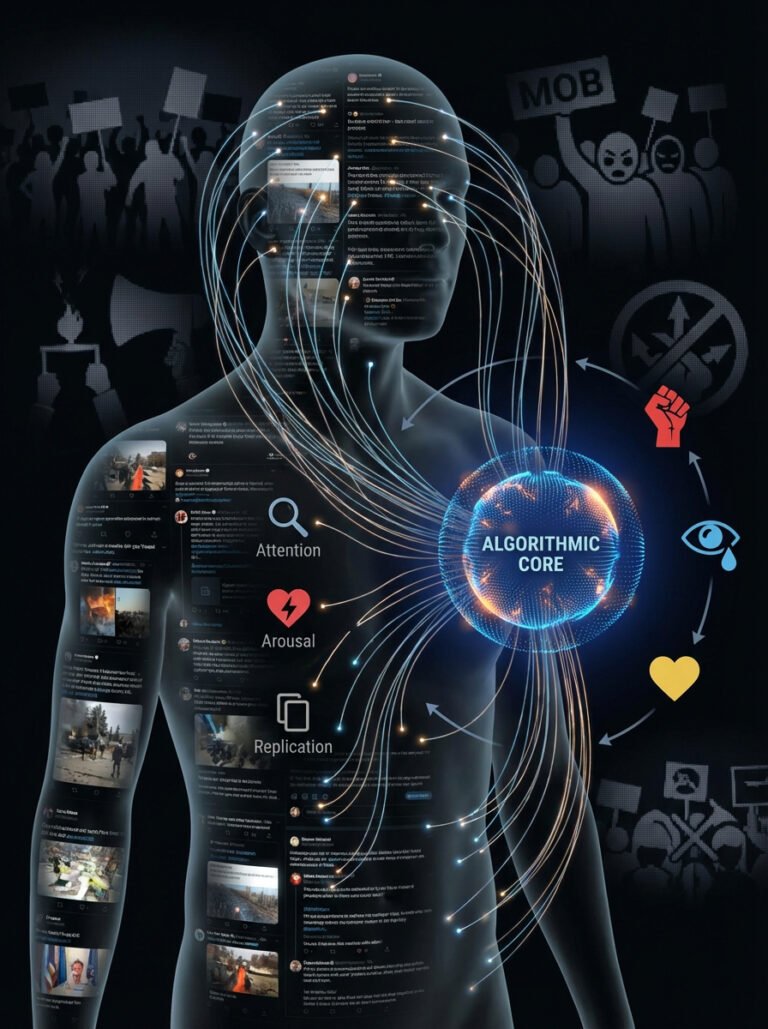
The Algorithm is designed to maximize engagement. What engages humans? Fear. Anger. Lust. Outrage.
So, the Algorithm naturally selects for Demonic Egregors. It promotes content that makes us fight. It feeds the thought-forms of polarization. We are unwittingly participating in a global black mass, sacrificing our peace of mind to entities of pure discord.
The “Dead Internet Theory” suggests that much of the internet is bots. If that is true, then the Egregors are now feeding themselves. The bots are liking the bots. The machine is chanting to the machine.
VII. Conclusion: Watch Your Feed
The next time you see a meme, look at it with your “Wizard Eyes.”
Don’t just laugh. Ask yourself:
- What idea is this symbol carrying?
- If I share this, what am I feeding?
- Is this a thought-form I want to make stronger?
You are a node in the network. You are a battery in the machine. Every click is a vote for reality.
We can use this power for good. We can create “Positive Egregors”—memes of hope, solarpunk visions, symbols of kindness. We can cast spells of connection.
But we have to be conscious of the magic. Because the God in the JPEG is hungry, and he doesn’t care if you think he’s real or not. He just wants your eyes.
References & Further Reading:
- Carroll, P. J. (1987). Liber Null & Psychonaut. (The foundational text on Chaos Magick and Sigils).
- Lachman, G. (2018). Dark Star Rising: Magick and Power in the Age of Trump. (Analysis of the Pepe/Kek phenomenon).
- David-Neel, A. (1929). Magic and Mystery in Tibet. (The Western introduction to the Tulpa concept).
- The Atlantic (2014). “The horror of Slenderman.” (Coverage of the stabbing and internet lore).
- Rushkoff, D. Program or Be Programmed. (On the agency of digital systems).