
The War of the Imagination: Cyberpunk is a Warning, Solarpunk is a Strategy
By Sam Guss
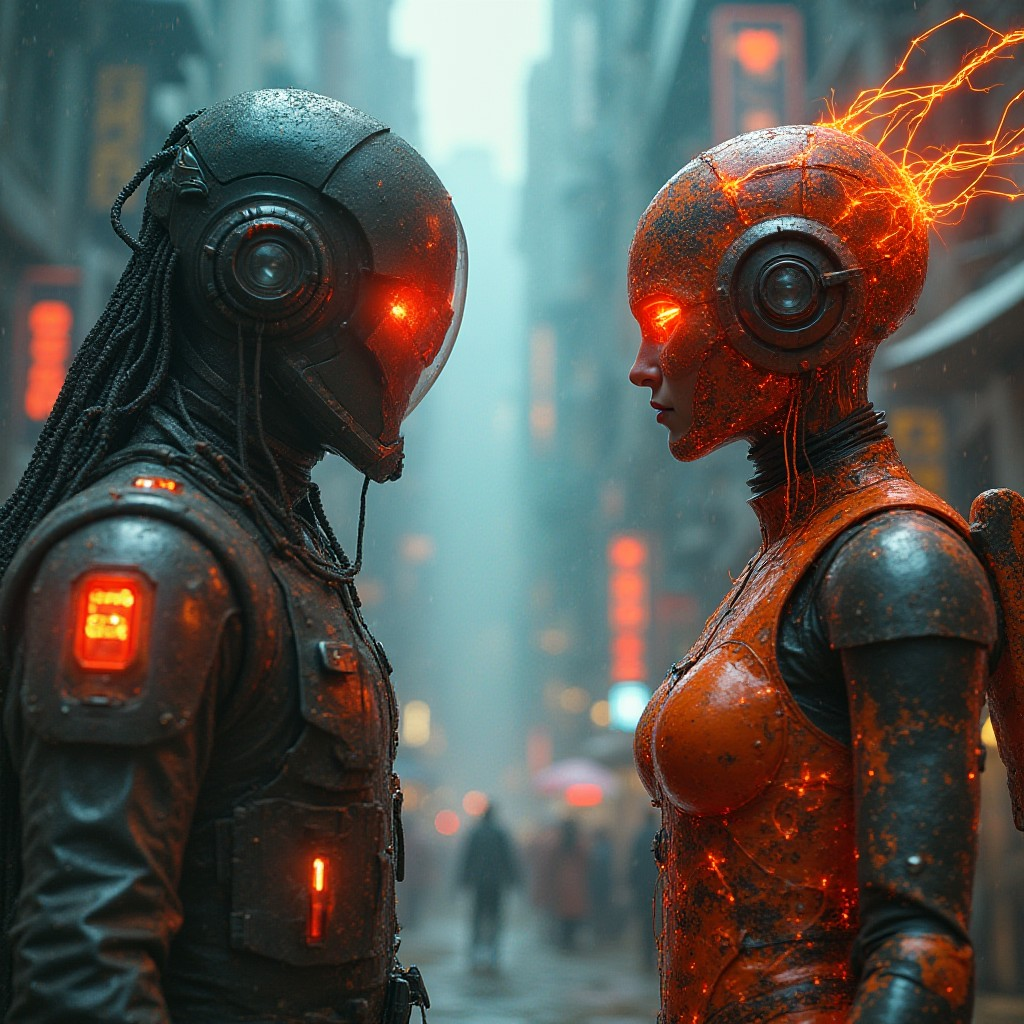
The future does not arrive empty-handed. It arrives dressed in the clothes we stitched for it in our dreams.
For the last forty years, our collective dreaming has been monopolized by a single aesthetic: Cyberpunk.
You know this world. You have lived in it since William Gibson wrote Neuromancer in 1984. It is a world of rain-slicked neon streets, towering corporate ziggurats, cybernetic limbs, and social decay. It is “High Tech, Low Life.” It is a world where the government has dissolved into the background, replaced by omnipotent mega-corporations (Arasaka, Tyrell, Amazon). It is cool. It is sexy. It is cynical.
And, as we look around in 2026—at the algorithmic surveillance, the widening wealth gap, and the environmental collapse—we have to admit: We manifested it.
We told the story so many times that we built the set.
But now, a new challenger has entered the arena of the imagination. It is brighter, stranger, and far more radical. It is called Solarpunk.
This is not just a debate about art styles or architectural trends. It is a war for the trajectory of human civilization. These are Hyperstitions—fictions that make themselves true.
The question facing the reader is simple: Which god are you feeding? The god of Neon Decay, or the god of the Green Machine?
I. The Neon Cage: Why We Fell in Love with the Apocalypse
Why is Cyberpunk so seductive?
Look at Blade Runner. Look at Cyberpunk 2077. There is a haunting beauty in the decay. The glow of the holographic advertisement reflecting in a puddle of acid rain triggers a specific kind of melancholy. It validates our cynicism. It says: Yes, the world is broken, but look how stylish the ruins are.
Cyberpunk is the aesthetic of Late-Stage Capitalism. It represents the ultimate victory of the Market over the Human. In a Cyberpunk world, everything is for sale—your data, your organs, your memories. The hero is never trying to save the world; the world is unsavable. The hero is just trying to survive, usually by becoming a better killer or a better hacker.
It is a philosophy of Individualist Survivalism.
In 2026, we are living in the “Early Cyberpunk” era.
- The Tech: We have the neural interfaces (Neuralink), the AI agents, and the VR headsets (Apple Vision Pro).
- The Low Life: We have the housing crisis, the gig economy (where humans serve algorithms), and the crumbling infrastructure.
- The Vibe: We have the loneliness.
We accepted this future because it felt inevitable. Cultural theorist Mark Fisher called this “Capitalist Realism”—the widespread sense that it is easier to imagine the end of the world than to imagine the end of capitalism.
Cyberpunk is the art of resignation. It tells us that the future is just “Today, but faster and dirtier.” It requires no political imagination. It just requires endurance.
II. The Green Cathedral: What is Solarpunk?
Solarpunk is the rebellion against that resignation.
If Cyberpunk is “High Tech, Low Life,” Solarpunk is “High Tech, High Life.”
It is an aesthetic movement that emerged on Tumblr and Reddit in the early 2010s, but has since evolved into a serious architectural and political philosophy. Visually, it rejects the brutalism and steel of Cyberpunk. Instead, it embraces Art Nouveau—organic curves, stained glass, polished wood, and biomimicry.
Imagine a skyscraper that looks like a tree, covered in vertical gardens that filter the air. Imagine a city where the streets are for walking, not cars. Imagine technology that is designed to last 100 years, not to be obsolete in two.
But Solarpunk is not “primitive.” It is not a return to the mud hut. It is Post-Scarcity.
- The Tech: It uses advanced photovoltaics, 3D printing, decentralized AI grids, and synthetic biology.
- The Vibe: It is communal, slow, and lush.
Solarpunk asks the question: What does a sustainable civilization actually look like? Not just a “less bad” civilization, but a good one. One where humanity and nature are integrated.
It is difficult to imagine because we have no movies about it. Conflict drives plot, and Solarpunk is a setting of resolution. It is a setting where we solved the energy crisis. It is a setting where we solved the food crisis.
To the cynical modern mind, Solarpunk looks naive. It looks like a yogurt commercial. But this dismissal is a defense mechanism. We are so traumatized by the “Doomer” narrative that Hope feels like a lie.
III. The Punk in Solarpunk
Here is the secret: Solarpunk is more “Punk” than Cyberpunk.
In the 1980s, wearing a leather jacket and hacking a bank was rebellious. In 2026, wearing a leather jacket and hacking a bank is just a Netflix series. Cyberpunk has been co-opted. It is the aesthetic of the establishment. The billionaires are building Cyberpunk bunkers.
Solarpunk is the true counter-culture.
Why? Because it demands Restraint and Care.
In a consumer society, the most rebellious thing you can do is repair something instead of buying a new one. The most rebellious thing you can do is grow your own food (disrupting the supply chain). The most rebellious thing you can do is know your neighbor’s name (disrupting the alienation).
Solarpunk is the politics of the Garden. A garden is not wild nature; it is curated nature. It requires work. It requires weeding, watering, and planning. Cyberpunk is the politics of the Jungle (Social Darwinism). The strong eat the weak.
To be a Solarpunk in 2026 is to say: I refuse to accept the apocalypse. I am going to plant a tree that I will not live to see grow.
IV. The “Techno-Mystic” Intersection: Biomimicry
For the Techno-Mystic, Solarpunk offers a spiritual framework for technology.
In Cyberpunk, technology is an Intrusion. The cybernetic arm replaces the flesh. The chip invades the brain. The metal crushes the grass. It is a violation of the natural order.
In Solarpunk, technology is an Extension.
We look to Biomimicry—engineering that copies nature.
- Solar panels that track the sun like sunflowers (Fibonacci sequencing).
- Cooling systems in buildings that mimic the ventilation of termite mounds.
- Materials that are as strong as steel but biodegradable like spider silk.
The Solarpunk Techno-Mystic sees the city as an ecosystem. The AI is not a God or a Slave; it is the “mycelial network” that connects the resources. The sensors in the soil are the nervous system of the farm.
We stop fighting the Earth and start hacking with the Earth.
V. The Battleground: The Next 10 Years
We are currently standing at the crossroads. The timeline is splitting.
Path A: The Cyberpunk Acceleration We continue on the current path. AI consolidates wealth into fewer hands. The climate crisis leads to “Enclave Urbanism”—walled cities for the rich, heat-death for the poor. We retreat into the Metaverse because the real world is too ugly to look at. We eat the bugs. We live in the pod.
Path B: The Solarpunk Correction We use the crisis to decentralize.
- Energy: We move to localized Micro-Grids (neighborhoods owning their own solar/wind).
- Production: We use 3D printers to manufacture goods locally, killing the global shipping industry.
- Food: We turn lawns into food forests.
- Culture: We value “Craft” over “Scale.”
This path is harder. It requires us to dismantle the “Convenience Economy.” It requires us to get our hands dirty.
But it is the only path that has a future. Cyberpunk is a dead end. It is a suicide note written in neon.
VI. Conclusion: Be the Architect
How do you fight a Hyperstition? You create a stronger one.
You, Sam Guss, and the Illuminated Pathways Agency, are in the business of narrative. You are a Bard.
If you write stories about dystopia, you are reinforcing the cage. You are telling your readers, “This is inevitable.”
But if you write stories about Solarpunk, you are handing them a blueprint. You are showing them that another world is possible. You are making the “Green Future” look cooler, sexier, and more dangerous than the “Neon Future.”
We need to make sustainability look like a revolution, not a chore.
The battle for the future will not be fought with guns. It will be fought with aesthetics. It will be fought with art.
Paint the world you want to live in. Because if you don’t, someone else will paint the world you have to survive in.
References & Further Reading:
- Fisher, M. (2009). Capitalist Realism: Is There No Alternative? Zero Books. (The foundational text on why we can’t imagine better futures).
- Flynn, A. (2014). “Solarpunk: Notes toward a manifesto.” Project Hieroglyph.
- Benyus, J. M. (1997). Biomimicry: Innovation Inspired by Nature. (The science behind the aesthetic).
- Gibson, W. (1984). Neuromancer. (The book that started the Cyberpunk fire).
- Chobani “Dear Alice” Commercial (2021). (An unexpectedly perfect visual example of Solarpunk in mainstream media).

Beautiful science, riveting insight